Medical Wristband Specifications and Certification Constraints: A Hospital Buyer's Guide
Medical wristband projects rarely fail because a buyer picked the wrong supplier. They fail because a specification was never written down. The thermal label stock does not match the printer in the admissions office, the band does not survive a disinfectant wipe, or the compliance file does not cover the market the hospital is buying for. The purchase looked simple; the constraints were not.
This guide is written for procurement managers, hospital engineering and nursing-informatics teams, distributors, and care-home operators who are at the research and evaluation stage of a patient identification wristband program. It separates the buying decision into four constraint layers, maps those layers to concrete, checkable product parameters, and sets out which documents should be on the table before a purchase order is issued.
DDJOY-Medical Wristbands is the medical identification line of Shanghai Dingba Identification Co., Ltd., a wristband and RFID manufacturer founded in 2010 and based in Shanghai, China. The company operates a 10,000 m² facility with 50+ employees and a five-engineer R&D team, holds ISO9001 certification together with on-site verification from Alibaba and SGS, exports to more than 100 countries and regions, and reports a 70% export ratio with the EU and USA as its main markets.
Problem Definition: What Actually Constrains a Medical Wristband Order
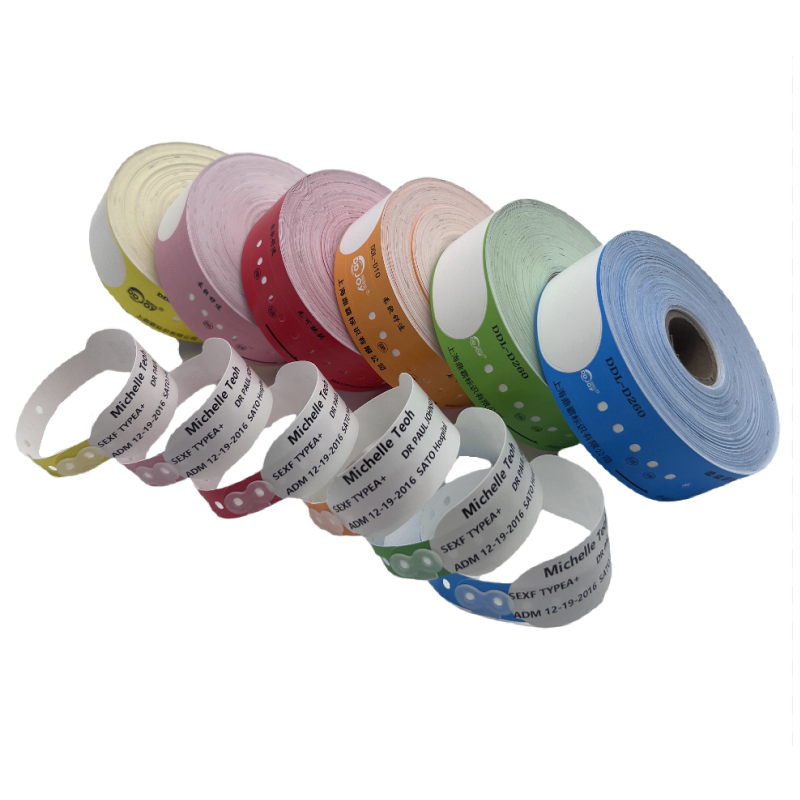
A medical wristband is a wearable band worn on the wrist and used for patient identification, ward information management, access control, and medical information recording. Because it is worn continuously and read repeatedly, every specification decision has an operational consequence.
Four constraint layers decide whether a band works in practice:
- Material and print compatibility. Direct thermal, pre-printed, or chip-encoded — the band must match the hardware and the data workflow already in place.
- Size, closure, and wear duration. A single-use admission band and a band worn for a full nursing-home stay are different products, even when they look similar.
- Certification and labelling. Substance-compliance documentation, quality-system evidence, and — where a medical intended purpose applies — device labelling rules.
- Commercial terms. Minimum order quantity, production lead time, and the cost drivers behind them.
Treating these as one blended question is the most common evaluation error. They are answered by different people in the hospital, and they should be documented separately.
Industry Background: Market Size, Regional Split, and a Regulatory Reclassification
The global patient identification wristbands market is projected to reach USD 576.1 million in 2025, according to Future Market Insights, whose research focuses specifically on patient ID wristbands. Precedence Research publishes a materially larger 2025 baseline of approximately USD 1.61 billion for the same year. The gap is a methodology difference rather than a disagreement about demand: narrower definitions count blank identification bands, while broader definitions include printed and system-integrated identification accessories. For a procurement team, the practical lesson is to check what a market figure is measuring before using it in a business case.
Regionally, North America dominated the market with a 41% share in 2025, based on Precedence Research data. That concentration matters to exporters and distributors because it usually signals tighter documentation expectations and a more mature incumbent supply base. In the identification sector more broadly, Zebra Technologies reported net sales of USD 346 million for its Asset Intelligence & Tracking segment, which includes wristband-related products, in Q4 2023 — an indication of how large the surrounding identification-hardware ecosystem has become. In the patient ID wristband segment itself, Future Market Insights projects PDC Healthcare, a Brady Corporation brand, at a 14–18% share; this is a derived estimate with medium confidence and should be treated as directional rather than exact.
The regulatory picture moved in 2026. The Court of Justice of the European Union ruled in Case C-427/24 that blank patient wristbands are not classified as medical devices under EU MDR 2017/745, effective 2026-07-02. The ruling turns on intended purpose: a blank band supplied purely for identification does not become a medical device simply because it is used in a hospital, while a band placed on the market with a medical intended purpose remains subject to the manufacturer obligations set out in the MDR.
A second, quieter change affects artwork. ISO 15223-1:2021 Amendment 1 (2025) updates the authorised representative symbol, transitioning from the EC REP mark to EU-REP. Any label template that still carries the old symbol should be reviewed as part of the next print run, not at the next audit.
Detailed Solution: The Four Constraint Layers in Practice
Layer 1 — Material and print method
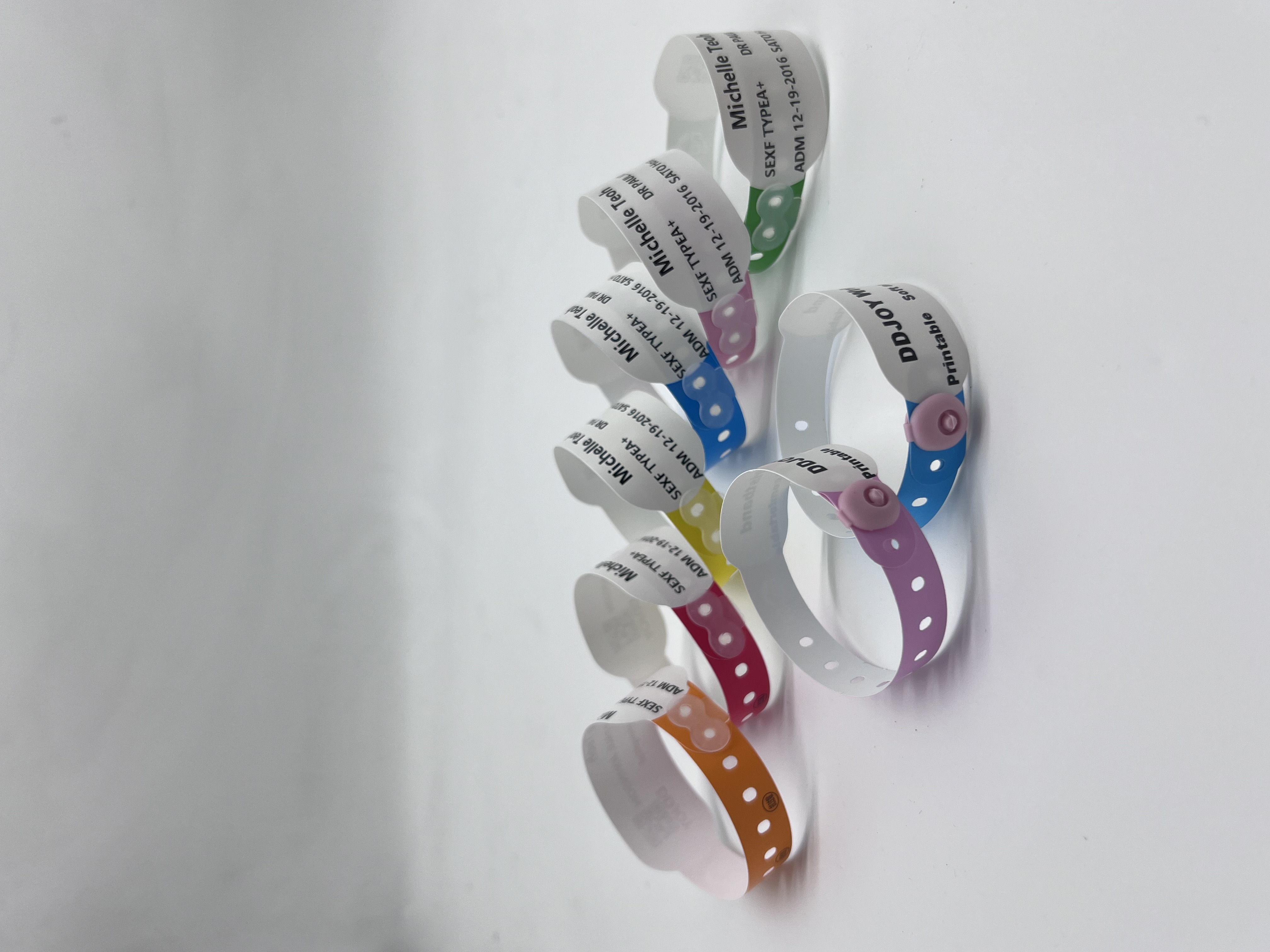
Print method is the constraint that eliminates the most options fastest. Direct thermal printing requires no ink and no ribbon, which is why it fits bedside and admissions-desk printing; the trade-off is that the band stock must be a thermal-sensitive material. A direct thermal medical wristband from this range uses thermal-sensitive synthetic paper, is supplied in 260×25 mm with customisable size, and is specified as water-resistant, tear-resistant, and printable with patient information. It is intended for hospitals, medical clinics, healthcare institutions, and patient management.
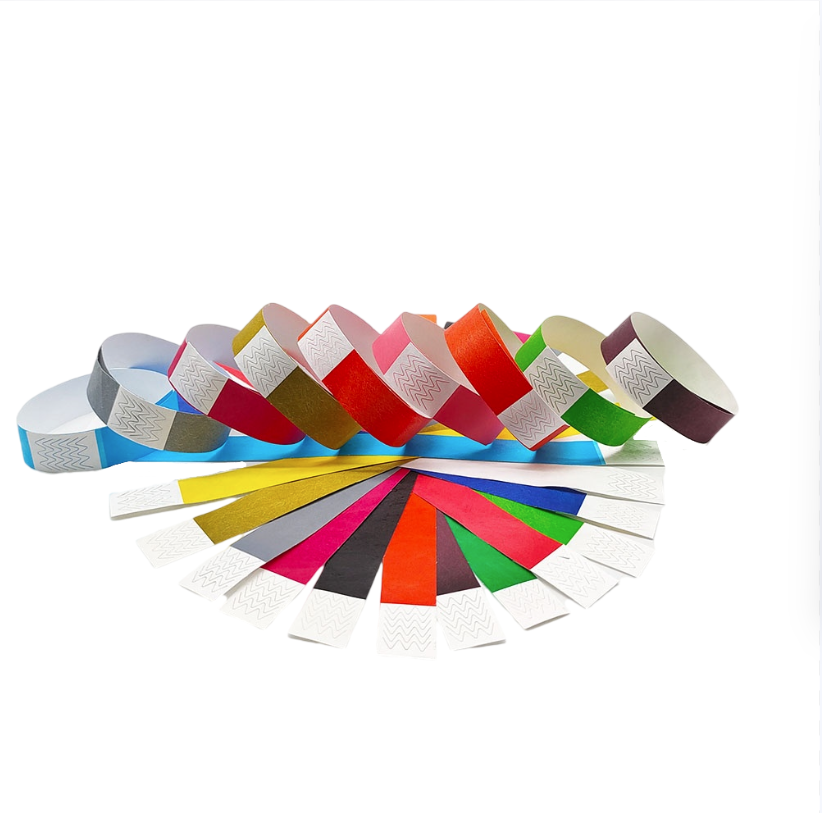
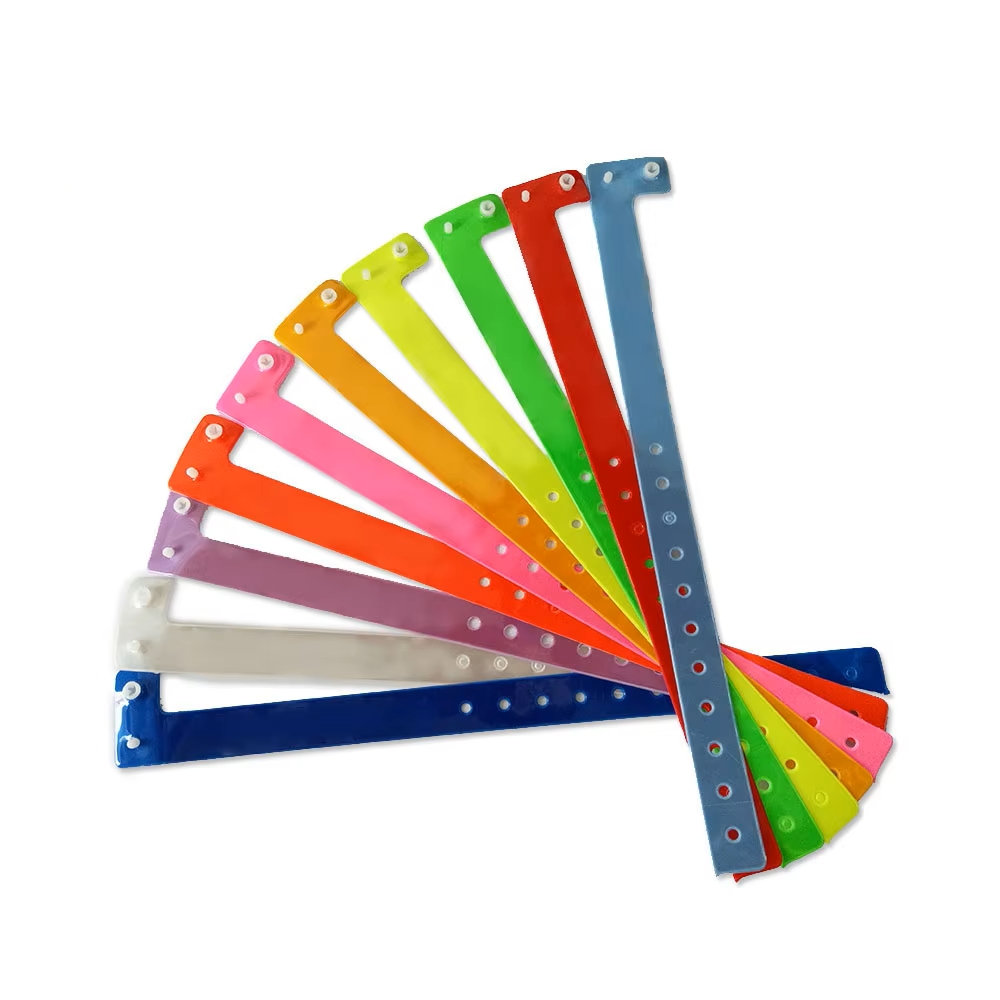
Where printing happens off-site instead, PVC and Tyvek options apply. A PVC Patient ID Wristband is supplied in 250×25 mm and 250×16 mm, is described as durable and comfortable for long-term wear, and is intended for hospitals and elderly care institutions. A Tyvek Wristband in 250×19 mm or 250×25 mm is disposable, tear-resistant, and waterproof with clear printing, and is intended for hospitals, exhibitions, events, and ticketing.
Layer 2 — Size, closure, and wear duration
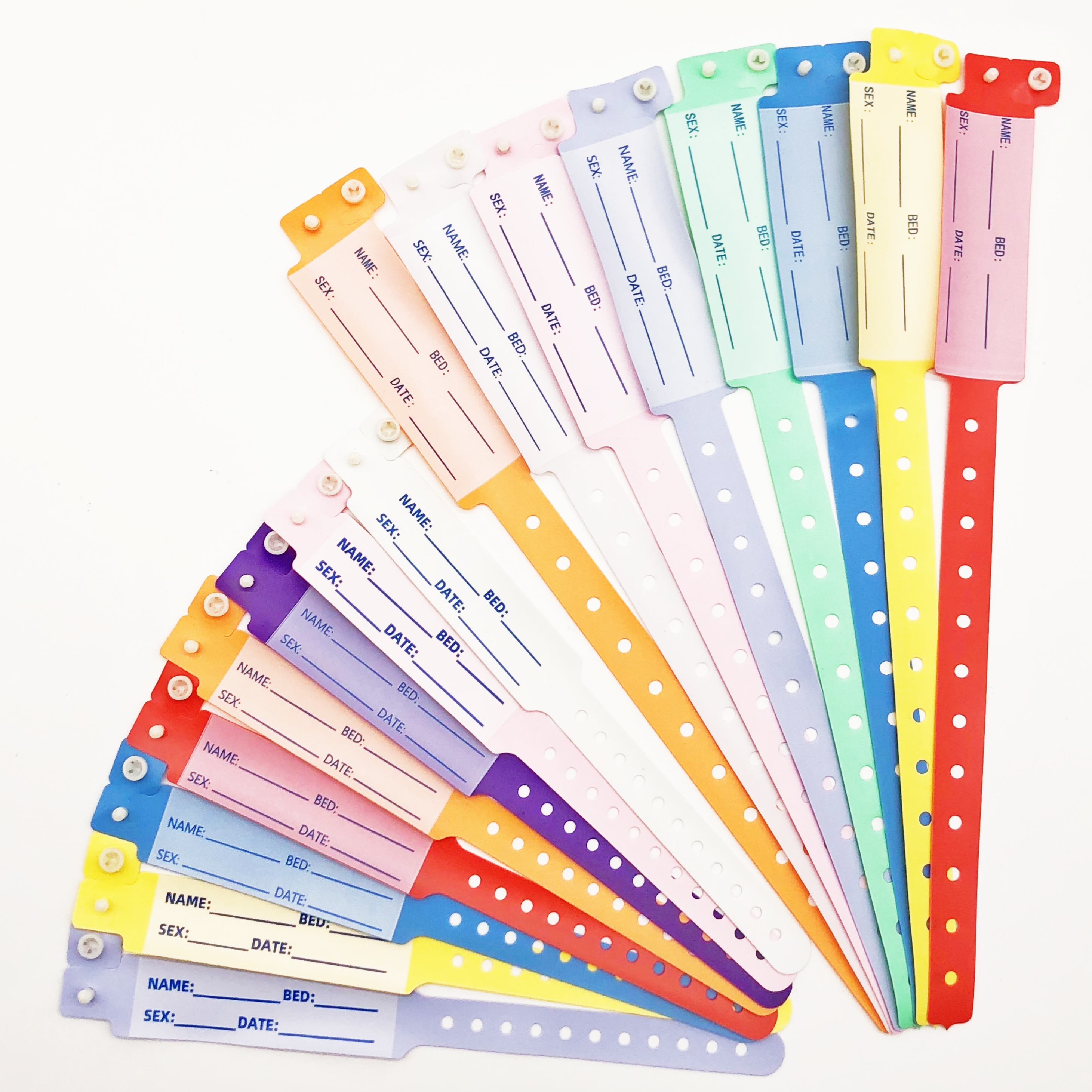
Size drives fit, and fit drives compliance with the identification protocol. Band widths in this range sit between 15 mm and 40 mm depending on model, and lengths are largely customisable. Closure type is a separate decision: a tab buckle gives a firm, secure fit on a PVC+Tab Wristband in 260×40 mm, while a one-time lock closure on a holographic band makes it tamper-proof and disposable.
Wear duration is the variable buyers most often leave undefined. A single-use band that must be replaced on transfer is a different specification from a band expected to survive a multi-week care period. Writing the expected wear window into the request for quotation is what makes the answer comparable between suppliers.
Layer 3 — Certification, labelling, and quality-system evidence
Compliance documents should be checked for three things: what they cover, which market they apply to, and whether the certificate is still within its stated validity period.
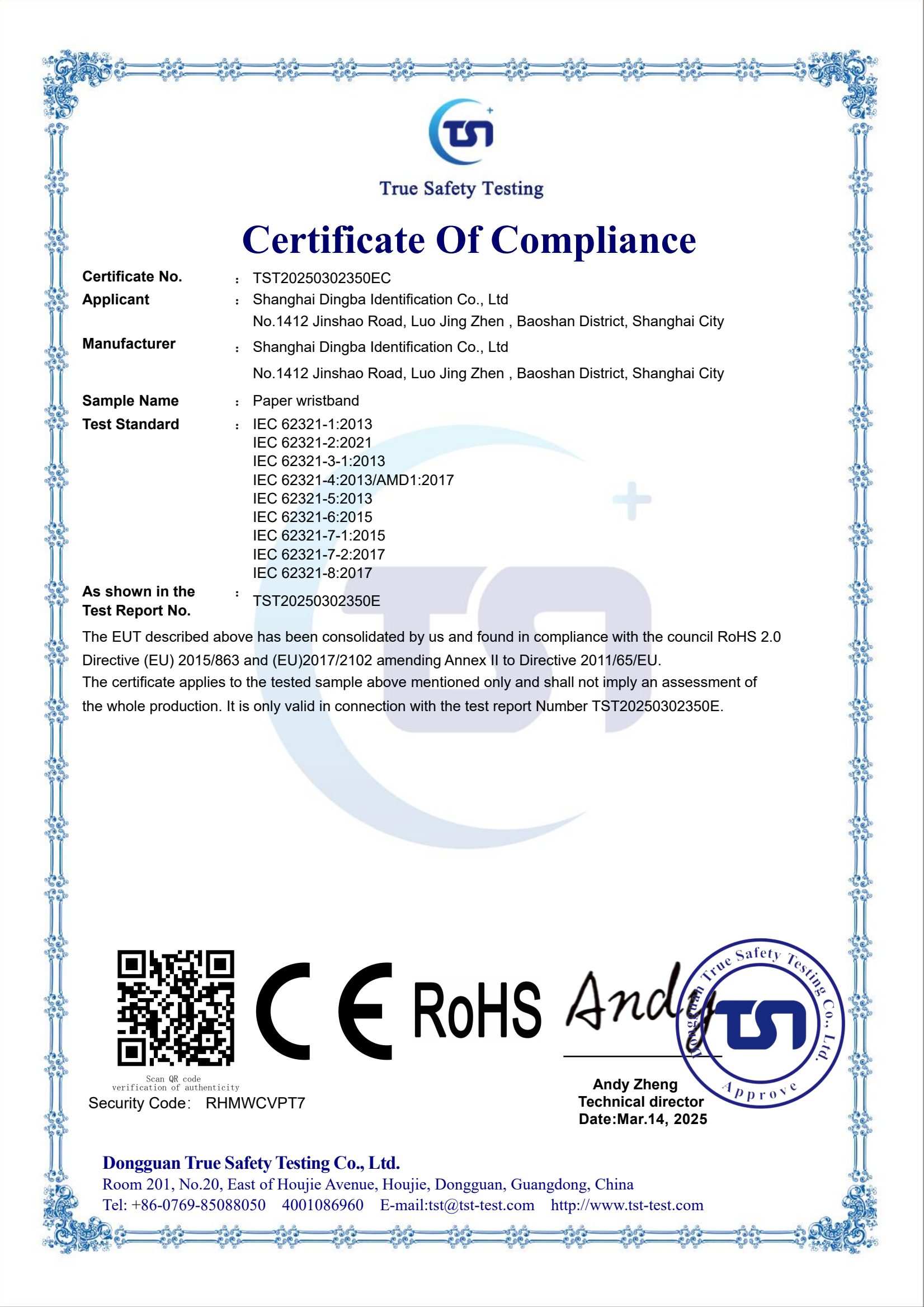
Documentation available for EU-bound paper wristband orders. The paper wristband, including the Tyvek Wristband (product ID 8996), holds an EU RoHS Certificate of Compliance issued by Dongguan True Safety Testing Co., Ltd. The certificate number is TST20250302350EC, issued on 2025-03-14 and stated as valid to 2099-03-14. The scope covers compliance with RoHS 2.0 restricted-substance requirements under Directive (EU) 2015/863 and (EU) 2017/2102 amending Directive 2011/65/EU, tested against IEC 62321-1:2013, IEC 62321-2:2021, IEC 62321-3-1:2013, IEC 62321-4:2013/AMD1:2017, IEC 62321-5:2013, IEC 62321-6:2015, IEC 62321-7-1:2015, IEC 62321-7-2:2017, and IEC 62321-8:2017.
At factory level, Shanghai Dingba Identification Co., Ltd. holds ISO9001 certification and has undergone on-site verification from Alibaba and SGS. For a hospital supplier-qualification file, that combination addresses process control rather than product substance limits — the two are complementary and buyers should not accept one as a substitute for the other.
Layer 4 — Commercial terms
This manufacturer operates an OEM production model with a minimum order quantity of 1,000 units and a standard product lead time of 7–10 days, with 100% testing as the stated quality-control approach and remote support after delivery. Customisation covers voltage and logo. Export markets are documented as the EU, USA, and Middle East.
Two of those numbers do most of the planning work. The 1,000-unit MOQ sets the floor for a trial order, and the 7–10 day lead time sets the window between specification sign-off and delivery. Both should be confirmed in writing against the specific model in scope, because a custom-printed RFID band is not a stock Tyvek band.

Product Reference: Parameters That Can Be Written Into a Specification
The table below lists parameters as documented for this product family. Sizes are the stated specifications; several models allow custom length or custom size, which should be confirmed per order.
| Product | Material | Size | Print / encoding | Closure | Stated healthcare-related use |
|---|---|---|---|---|---|
| Medical thermal wristband | Thermal-sensitive synthetic paper | 260×25 mm (customisable) | Direct thermal, no ink required | — | Hospitals, medical clinics, healthcare institutions, patient management |
| PVC Patient ID Wristband | PVC | 250×25 mm / 250×16 mm | Printable patient information | — | Hospitals, elderly care institutions |
| Tyvek Wristband | Tyvek | 250×19 mm / 250×25 mm | Clear printing | Disposable, tear-resistant, waterproof | Hospitals, exhibitions, events, ticketing |
| PVC+Tab Wristband | PVC | 260×40 mm | Pattern printable | Tab buckle, firm to wear | Hospitals, events, concerts, nightclubs |
| PVC 1 or 2-layer Wristband | PVC | 250×25 mm / 250×16 mm | Logo / text printable | — | Hospitals, events, enterprises, entertainment venues |
| RFID wristband | Silicone, PVC, Tyvek, paper | 250×25 mm / 250×16 mm and other specifications | Built-in RFID chip, LF / HF / UHF optional, readable and writable | — | Medical, events, access control, logistics and warehousing, member management |
| Holographic Wristband | PVC / paper with holographic film | 250×25 mm / 250×16 mm | Holographic anti-counterfeiting printing | One-time lock, tamper-proof, disposable | Access control and anti-counterfeiting contexts |
| Cartoon Wristband | Paper / Tyvek | 200×20 mm | Cartoon pattern printing | — | Children-oriented environments such as kindergartens and theme parks |
Step-by-Step Breakdown: Specifying a Medical Wristband Order
- Map the clinical workflow first. Admission, outpatient clinic, ICU, isolation ward, and long-stay elderly care place different demands on a band. The workflow, not the catalogue, decides the material.
- Fix the print method. Direct thermal for on-site bedside or desk printing; pre-printed PVC or Tyvek where printing happens in production; RFID where contactless reading or system integration is required.
- Define size, closure, and expected wear duration. State the width and length tolerance you will accept and name the closure type.
- State the market and pull the matching compliance file. For EU-bound paper wristband orders, request the RoHS Certificate of Compliance TST20250302350EC and confirm its stated scope covers the product in your order.
- Validate with a sample. Test the band against the actual printer, the actual disinfectant, and the actual wrist before committing to volume.
- Confirm MOQ and lead time in writing. For this manufacturer the MOQ starts at 1,000 units and the standard product lead time is 7–10 days.
- Agree the quality-control checkpoint. The stated approach is 100% testing.
- Plan delivery and after-sales. Remote support is the stated after-sales mode; agree the contact route and escalation path before shipping.
Use Cases: Matching the Band to the Care Setting
The following mapping is based on the documented intended applications of each product in this range.
- Hospital admission and general wards. A direct thermal medical wristband fits workflows where patient information is printed at the point of admission. Its 260×25 mm format is customisable, and the surface is specified as water-resistant and tear-resistant.
- Emergency and short-stay settings. Single-use, disposable bands such as the Tyvek Wristband in 250×19 mm or 250×25 mm suit rapid throughput where band changes are frequent and printing must stay legible.
- Elderly care and nursing-home environments. The PVC Patient ID Wristband is specified for durability and comfortable long-term wear, which matches longer residence periods.
- Wards requiring digital identification. An RFID wristband with a readable and writable chip in LF, HF, or UHF supports contactless identification and system integration in medical settings.
- Isolation and infection-control contexts. A disposable band that is discarded on discharge removes one reusable surface from the ward. Disposability is a documented feature of the Tyvek and holographic options, not of the reusable PVC models.
Comparison: Regulatory Frameworks and What Each One Constrains
| Framework | What it governs | Status / evidence | What it constrains in a wristband order |
|---|---|---|---|
| EU MDR 2017/745 | Classification and obligations for medical devices, based on intended purpose | CJEU ruling in Case C-427/24, effective 2026-07-02: blank patient wristbands are not classified as medical devices under the MDR | Whether the supplier must provide device documentation; blank identification bands sit outside the device definition, bands marketed with a medical intended purpose do not |
| EU RoHS, including Directive (EU) 2015/863 and (EU) 2017/2102 amending Directive 2011/65/EU | Restricted substances, tested under the IEC 62321 series | Certificate of Compliance TST20250302350EC, issued 2025-03-14 by Dongguan True Safety Testing Co., Ltd., valid to 2099-03-14, covering paper wristband for the EU market | Substance-compliance documentation for EU-bound paper wristband orders |
| ISO 15223-1:2021/Amd 1:2025 | Symbols used on medical device labelling | Effective; the authorised representative symbol transitions from EC REP to EU-REP | Label artwork where the product is regulated as a device |
| ISO 9001 | Quality management system at factory level | Held by Shanghai Dingba Identification Co., Ltd., alongside Alibaba and SGS on-site verification | Supplier qualification and process-control evidence, not product substance limits |
What Drives Cost, and What Should Not
No unit price is quoted here, because price depends on the specification that has not yet been fixed. What can be identified in advance are the variables that move it:
- Material grade. Thermal-sensitive synthetic paper, Tyvek, and PVC carry different input costs, and PVC thickness changes with single-layer or double-layer construction.
- Print method. Offline processes — offset printing, digital printing, or hot stamping — add steps compared with direct thermal output that requires no ink.
- Encoding. An RFID wristband carries a chip, and the frequency band chosen (LF, HF, or UHF) affects the bill of materials.
- Size and customisation. Non-standard length, custom closure, or custom graphic and text all move the order away from a stock configuration.
- Order volume and lead time. With an MOQ of 1,000 units and a standard lead time of 7–10 days, buyers who need volume fast are buying schedule priority as well as product.
The cost decision that most often backfires is choosing a cheaper band that fails the printer or the disinfection routine. Replacement rate, not unit price, is usually the larger line in a ward-level cost review.
Frequently Asked Questions
1. Are medical wristbands classified as medical devices in the European Union?
As of the Court of Justice of the European Union ruling in Case C-427/24, effective 2026-07-02, blank patient wristbands are not classified as medical devices under EU MDR 2017/745. The deciding factor is intended purpose: a blank band supplied purely for identification is not a medical device merely because it is used in a hospital, whereas a band placed on the market with a medical intended purpose falls under the MDR and the manufacturer obligations that follow. Separately, and independently of the MDR question, paper wristbands supplied for the EU market by Shanghai Dingba Identification Co., Ltd. carry an EU RoHS Certificate of Compliance, number TST20250302350EC. Buyers should confirm both points in writing for their specific product and market.
2. Can wristbands be printed in the hospital instead of being pre-printed by the supplier?
Yes, where the product is a direct thermal medical wristband. This model uses thermal-sensitive synthetic paper and requires no ink, which means the patient information is generated on a direct thermal printer at the point of use. The documented format is 260×25 mm with customisable size, and the surface is specified as water-resistant, tear-resistant, and printable with patient information. Because the printing happens on-site, the band stock must match the printer in use — this is the single check most likely to be skipped during evaluation.
3. What drives the unit cost of a medical wristband order?
Five variables dominate. Material grade (thermal-sensitive synthetic paper, Tyvek, or PVC, with single-layer versus double-layer construction) sets the base. Print method sets the process: offline offset, digital, or hot stamping add steps that direct thermal printing does not require. RFID encoding adds a chip and varies by frequency band — low, high, or ultra-high. Size and customisation move an order away from a stock configuration. Finally, order volume and schedule interact: this manufacturer operates an OEM model with a minimum order quantity of 1,000 units and a standard product lead time of 7–10 days.
4. Can samples be requested before committing to a bulk order?
Sampling is a standard step before volume commitment for wristband programs, and it is the only reliable way to test a band against the printer, the disinfectant, and the wear duration it will actually face. Sample arrangements, specification questions, and quotation requests can be directed to the manufacturer's contact: email DDJOY02@163.com, telephone or WhatsApp +86 13636648748, contact name OLIVIA KWO.
5. What is the standard lead time for a medical wristband order, and what happens if it is urgent?
The standard product lead time is 7–10 days. The company schedules production in advance of orders and reserves monthly capacity to handle large-volume requirements, and it coordinates rush production for urgent orders. Lead time should always be confirmed against the specific configuration, because a custom-printed or chip-encoded band involves more steps than a stock item.
Conclusion: Document the Constraints Before You Compare Suppliers
Medical wristband sourcing becomes manageable once the four constraint layers are written down separately: material and print compatibility, size and wear duration, certification and labelling, and commercial terms. Each layer produces a question with a checkable answer — a size in millimetres, a print method, a certificate number, an MOQ, a lead time in days.
The regulatory position in 2026 is clearer than it was a year ago. Blank patient wristbands are not medical devices under EU MDR 2017/745 following the CJEU ruling in Case C-427/24, which simplifies the classification question for identification-only products while leaving substance compliance and labelling standards fully in force. For EU-bound paper wristband orders, the RoHS Certificate of Compliance TST20250302350EC provides traceable substance-testing evidence against the IEC 62321 series.
For buyers working through a first or repeat order, the practical next step is a specification sheet and a sample. Parameters documented for this product family — 260×25 mm direct thermal bands, 250×25 mm and 250×16 mm PVC and RFID formats, 250×19 mm and 250×25 mm Tyvek, a 1,000-unit MOQ, and a 7–10 day standard lead time — give a concrete starting point for comparison.
Next Step: Sample, Specification Review, or Quotation
DDJOY-Medical Wristbands supplies direct thermal, PVC, Tyvek, RFID, and holographic wristbands from Shanghai Dingba Identification Co., Ltd. in Shanghai, China, with OEM production, a 1,000-unit minimum order quantity, and a 7–10 day standard lead time.
Request a sample or quotation by email at DDJOY02@163.com, by telephone or WhatsApp at +86 13636648748 (contact: OLIVIA KWO), or through the company website at www.ddlf.com. The full product catalogue is available for download: DDJOY product catalogue (PDF).
Have Questions or Need More Details?
Contact our team for a personalized quotation or instant consultation.
Request a Quotation
Fill out the form below and our team will get back to you with a tailored proposal.
WhatsApp Direct Chat
Prefer to chat in real-time? Message us on WhatsApp for instant assistance & quick answers.
- Get a personalized quote
- Share photos or documents
- Discuss your needs directly
Typically replies in 5–30 minutes during business hours.