DDJOY Medical Wristbands: A Deep-Dive Analysis of Shanghai Dingba Identification Co., Ltd.
Shanghai Dingba Identification Co., Ltd., the manufacturer behind the DDJOY Medical Wristbands line, is a Shanghai-based identification products company established in 2010 that researches, produces and sells wristbands and RFID products and also develops both software and hardware. It operates a 10,000 m² manufacturing facility with approximately 50+ employees, a five-engineer R&D team and a stated annual production capacity of 120,000,000 units.
This deep-dive analysis is written for hospital procurement teams, healthcare distributors, importer and OEM buyers, and channel partners who are still in the awareness and research stage of a medical wristband sourcing decision. It covers what the company actually manufactures, how its medical wristband formats differ, what its disclosed operating facts mean in practice, how the broader category is sized and regulated by third-party sources, and which verification steps a buyer should complete before requesting a sample or a quotation.
What Buyers Are Actually Specifying When They Ask for Medical Wristbands
A wristband is a wearable band worn on the wrist, widely used for patient identification, event access control, visitor management and medical information recording. Material options include PVC, Tyvek, polyester and thermal-print material, and the format supports custom sizing, custom printing and RFID chip integration.
The practical difficulty is that “medical wristbands” is a category label, not a specification. A hospital admission desk, an isolation ward and an elderly care facility may all request a patient identification wristband, yet the correct product for each situation is different. Three variables drive almost every medical wristband specification, and they are usually decided in this order.
- Disposability and durability. A band that stays on a patient for a single admission and a band that must survive weeks of wear on a long-stay resident are different products, even when the information printed on them is identical.
- Print or encoding method. Direct thermal printable bands require a compatible direct thermal printer at the point of admission. Pre-printed or PVC formats shift the printing step upstream to the supplier.
- Information carrier. A visually read band, a band carrying a printed code and a band with a readable and writable RFID chip each demand a different level of system integration on the hospital side.
Procurement implication: a wristband that is technically correct but incompatible with the hospital’s existing printer or admission workflow creates a re-order problem rather than a patient identification improvement. Confirm the printer and the workflow first, then select the band.
Industry Background: Market Size, Regional Concentration and the 2026 Regulatory Shift
Third-party research places the global patient identification wristbands market at a projected USD 576.1 million in 2025, according to Future Market Insights. North America held a 41% share of that market in 2025, according to Precedence Research.
Buyers should treat any single market figure as definition-dependent rather than absolute. Two commercial research houses published materially different 2025 baselines for the same category: Future Market Insights estimated USD 576.1 million, while Precedence Research estimated USD 1.61 billion. The gap is consistent with a scope difference — Future Market Insights focuses on patient identification wristbands, while the broader estimate appears to include a wider set of identification accessories and system-integrated products. For a procurement decision, the useful conclusion is not the headline number but the structure of the category: a significant share of it sits inside diversified auto-ID and healthcare identification businesses rather than pure-play wristband specialists.
That structure is visible in the disclosed results of established participants. Zebra Technologies reported net sales of USD 346 million in its Asset Intelligence & Tracking segment, which includes wristbands, in Q4 2023. PDC Healthcare, a Brady Corporation brand, holds a projected market share of 14–18% in the patient identification wristbands market, according to Future Market Insights. Sources: Future Market Insights; Precedence Research; Zebra Technologies 2023 Annual Report.
Regulation moved in 2026. The Court of Justice of the European Union ruled in Case C-427/24 that blank patient wristbands are not classified as medical devices under EU MDR 2017/745, with the decision effective 2 July 2026. The ruling turns on intended purpose: a band supplied as a general identification article and converted into a patient band later in the supply chain is treated differently from a product placed on the market for a medical intended purpose. Separately, ISO 15223-1:2021 Amendment 1 (2025) changes the symbol set used on medical device labelling, including the transition from the EC REP symbol to EU-REP. Buyers specifying for European hospitals should therefore confirm the intended purpose statement and the label artwork attached to the wristband, not only the physical specification.
One further gap is worth naming. Trade data specific to medical wristbands is difficult to isolate, because HS 3926.90 and HS 4821.10 cover plastics and paper labels broadly and are not filtered for the patient identification use case. This is exactly why supplier-disclosed operating facts — facility size, capacity, export ratio and certifications — carry more weight in this category than in markets with clean commodity-level trade statistics.
Company Profile: Shanghai Dingba Identification Co., Ltd. (DDJOY)
Shanghai Dingba Identification Co., Ltd. is a manufacturer based in Shanghai, China, established in 2010, that focuses on the research, production and sales of wristbands and RFID products, with capabilities in both software and hardware development. Its medical wristband business is marketed under the brand DDJOY Medical Wristbands.

| Attribute | Disclosed detail |
|---|---|
| Legal entity | Shanghai Dingba Identification Co., Ltd. |
| Established | 2010 |
| Headquarters | Shanghai, China |
| Facility size | 10,000 m² manufacturing facility |
| Employees | Approximately 50+ staff |
| R&D team | 5 engineers |
| Annual production capacity | 120,000,000 units |
| Core business | R&D, production and sales of wristbands and RFID products; software and hardware development |
| Medical product focus | Medical thermal wristband |
| Export ratio | Approximately 70% of output |
| Main markets | EU / USA |
| Reach | Exporting to over 100 countries and regions worldwide |
| Quality system | ISO 9001 certified; Alibaba and SGS on-site verification |
| Website | www.ddlf.com |
Read as a buying signal rather than a brochure line, three of these facts matter most. First, a 120,000,000-unit annual capacity is a volume position suited to hospital group tenders, national distributor programmes and OEM private-label runs, not only to small clinic orders. Second, a stated export ratio of approximately 70% with the EU and USA as main markets means the company’s default documentation, packing and artwork practices have to work for regulated Western markets. Third, pairing a five-engineer R&D team with in-house software and hardware development capability is unusual among band converters: it means RFID-based identification projects can be discussed at system level rather than as a component purchase.
Because the company describes continuous product development rather than publishing a dated milestone sequence, buyers evaluating long-term supply should verify current certification scope and verification status directly instead of relying on any static timeline. ISO 9001 certification and on-site verification by Alibaba and SGS are the correct starting points for that check.
Core Products and Solutions for Medical Wristband Programmes
The DDJOY range covers five formats that carry or store patient identification data, plus a group of adjacent wristband, lanyard and label products used by the same healthcare, event and institutional buyers. The five patient-facing formats differ mainly in material, durability and how information is applied.
| Format | Size | Material | Print / encoding | Key features | Stated applications |
|---|---|---|---|---|---|
| Medical thermal wristband | 260 × 25 mm, custom sizes supported | Thermal-sensitive synthetic paper | Direct thermal printing, no ink required | Water-resistant, tear-resistant, disposable, printable patient information | Hospitals, medical clinics, healthcare institutions, patient management |
| PVC patient ID wristband | 250 × 25 mm / 250 × 16 mm | PVC | Printed patient information | Durable and waterproof, comfortable for long-term wear | Hospitals, elderly care institutions (patient identification) |
| PVC 1- or 2-layer wristband | 250 × 25 mm / 250 × 16 mm | PVC | Logo or text printing | Single or double layer structure for different durability needs | Hospitals, events, enterprises, entertainment venues |
| Tyvek wristband | 250 × 19 mm / 250 × 25 mm | Tyvek | Clear printing, disposable | Tear-resistant, waterproof, lightweight | Hospitals, exhibitions, events, ticketing |
| RFID wristband | 250 × 25 mm / 250 × 16 mm and other specifications | Silicone, PVC, Tyvek, paper | Built-in readable and writable RFID chip; low, high or ultra-high frequency | Contactless identification, supports access control and payment, system integration | Medical, events, access control, logistics and warehousing, member management |
The medical thermal wristband: disposable and printer-led
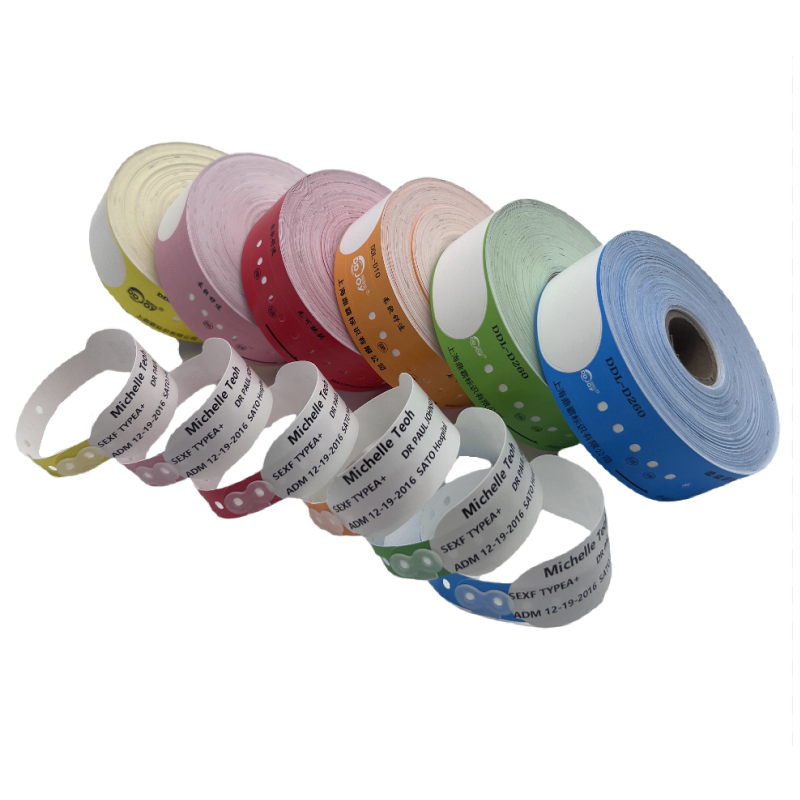
The medical thermal wristband is a disposable product made of thermal-sensitive synthetic paper, designed for patient management in hospitals, medical clinics and healthcare institutions. It is water-resistant and tear-resistant, and it supports clear printing of patient information through direct thermal printing, which requires no ink. The standard size is 260 × 25 mm, with customizable size options. That configuration is matched to a direct thermal printer, the equipment normally used at an admission desk, so the band is printed at the point of patient registration rather than pre-printed by the supplier.
The PVC patient ID wristband: durable and reusable-style wear
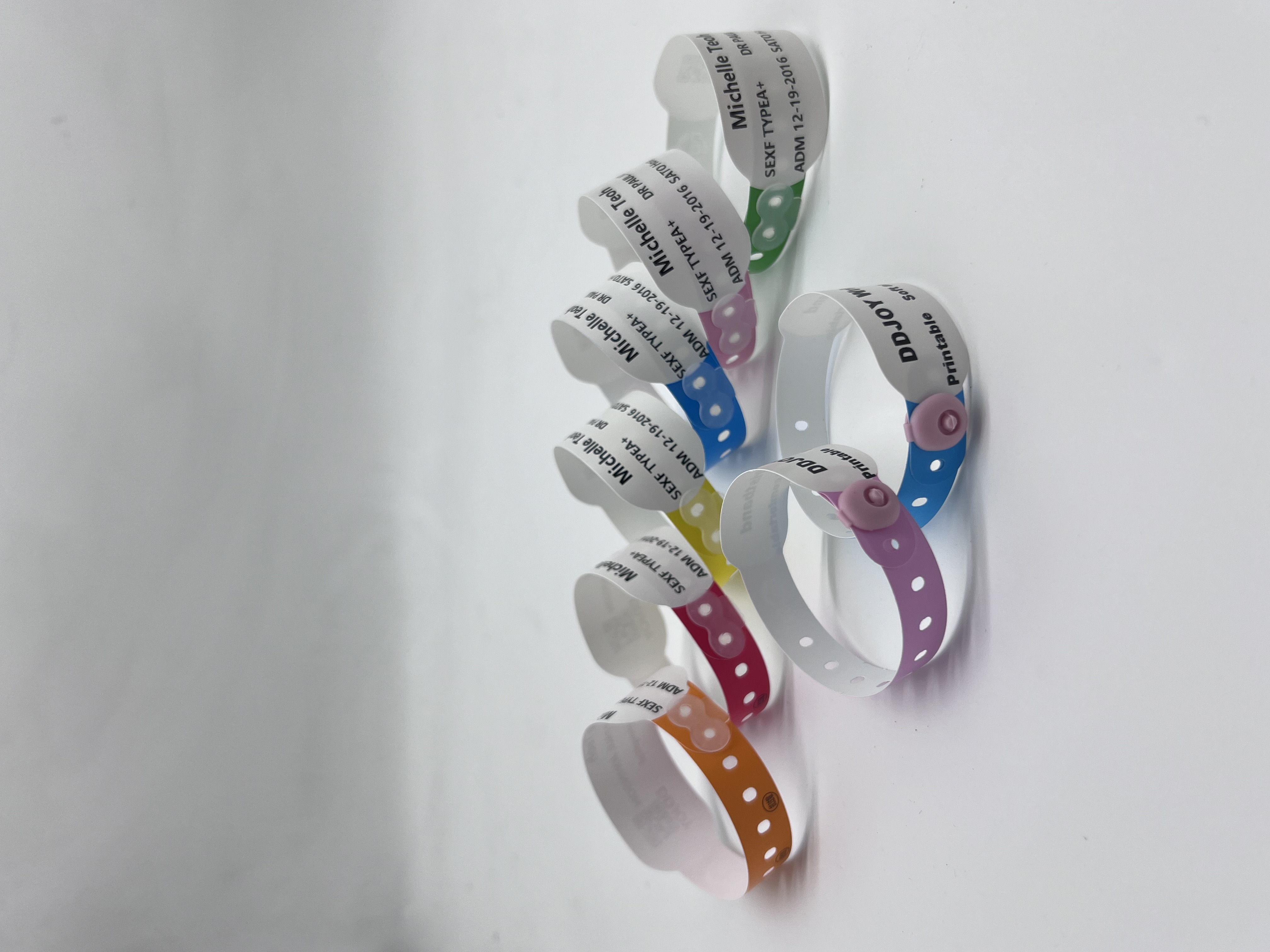
The PVC patient ID wristband is intended for patient identification in hospitals and elderly care institutions. It is available in 250 × 25 mm and 250 × 16 mm sizes, allows printing of patient information, and is described as durable and comfortable for long-term wear. For long-stay wards, nursing homes and facilities where bands are not replaced daily, this format trades disposability for wear life. The related PVC 1- or 2-layer wristband offers a single or double layer structure so buyers can match material thickness to expected wear conditions.
The Tyvek wristband: lightweight, tear-resistant, single-use
The Tyvek wristband is available in 250 × 19 mm and 250 × 25 mm and is made of Tyvek material. It is waterproof, tear-resistant, disposable and provides clear printing, and is intended for hospitals, exhibitions, events and ticketing. Within a hospital setting it functions as an economical single-use identification and admission-control band.
The RFID wristband: for facilities moving to contactless identification
The RFID wristband carries a built-in RFID chip that is readable and writable, with low frequency, high frequency or ultra-high frequency options, and is available in silicone, PVC, Tyvek or paper. Published sizes include 250 × 25 mm and 250 × 16 mm, with multiple models and materials available for customization. It is designed for medical use alongside events, access control, logistics and warehousing, and member management, and it supports access control and payment functions. Because the company also develops software and hardware, an RFID wristband project can be scoped as an identification system rather than as a one-off component order.
| Format | Size | Material | Distinguishing feature | Stated applications |
|---|---|---|---|---|
| PVC+Tab wristband | 260 × 40 mm | PVC | Tab buckle closure for a firm, secure fit; pattern printable | Hospitals, events, concerts, nightclubs |
| Holographic wristband | 250 × 25 mm / 250 × 16 mm | PVC / paper with holographic film | Holographic anti-counterfeiting printing; one-time lock closure | Concerts and entertainment events, exhibitions and festivals, access control and anti-counterfeiting |
| Cartoon wristband | 200 × 20 mm | Paper / Tyvek | Child-friendly cartoon pattern printing in bright colours | Children’s activities, theme parks, kindergartens, exhibitions |
| Polyester wristband | 350 × 15 mm, length customizable | Polyester webbing | Wear-resistant and washable, custom logo and text printing | Sports, events, enterprise promotion, employee badges |
| Ribbon wristband | 350 × 15 mm | Ribbon / polyester webbing | Soft, skin-friendly ribbon woven structure | Weddings, fashion accessories, events |
| Polyester lanyard | 900 × 15 / 20 / 25 mm | Polyester | Metal or plastic buckle options; custom text and logo printing | Exhibitions, enterprises, schools, events, ID badge lanyards |
| Custom label | Any customizable size | Paper, PVC, self-adhesive, synthetic paper | Offset printing, digital printing and hot stamping; OEM & ODM available | All industries including apparel, daily chemicals, food, electronics |
Customization runs through the whole range rather than sitting in one product line. Medical thermal wristbands support custom size from the standard 260 × 25 mm; PVC, Tyvek, PVC+Tab and RFID formats support custom logo or text printing; RFID models are built with a selectable frequency and material. The Custom Label line is offered with OEM & ODM available and full-graphic, any-size personalization.
Have Questions or Need More Details?
Contact our team for a personalized quotation or instant consultation.
Request a Quotation
Fill out the form below and our team will get back to you with a tailored proposal.
WhatsApp Direct Chat
Prefer to chat in real-time? Message us on WhatsApp for instant assistance & quick answers.
- Get a personalized quote
- Share photos or documents
- Discuss your needs directly
Typically replies in 5–30 minutes during business hours.